News
Automated battery dismantling moving from simulations to lab validation
15/01/2026
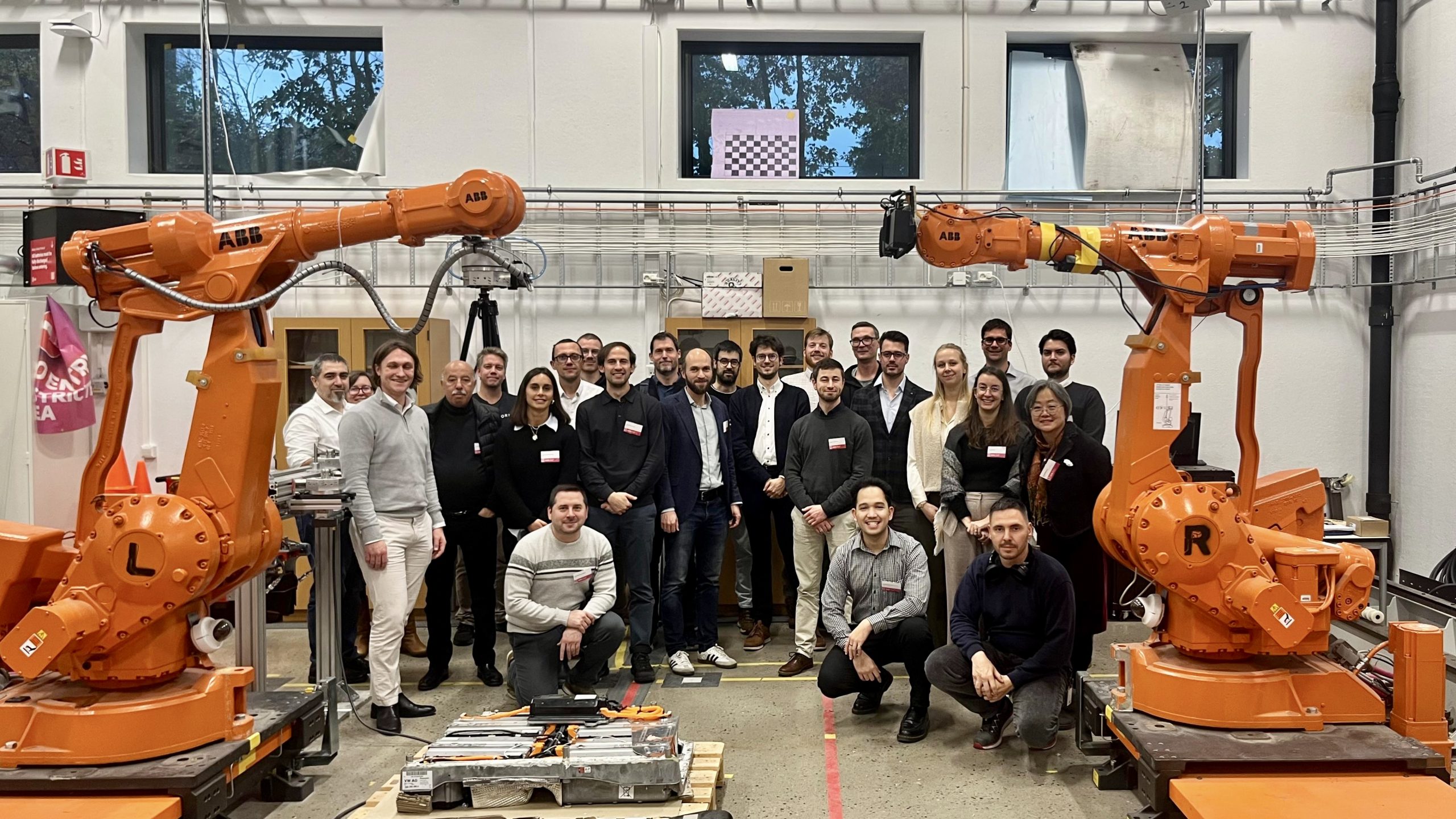
The RHINOCEROS project has reached a turning point in its efforts to automate the dismantling of end-of-life [EoL] electric vehicle batteries. If in the previous communications, researchers at the Faculty of Engineering and Science within the University of Agder [UiA] were developing digital simulators and algorithms to plan disassembly sequences, this reporting brings updates about the validation of the robotic systems and the introduction of a cognitive agent for adaptive execution.
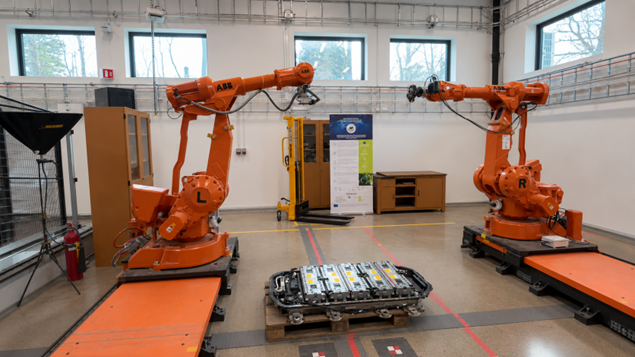
Researchers first developed a Disassembly Process Plan [DPP], where they optimised complex scheduling problems, such as planning time and tool allocation for dismantling operations. More recently, the UiA team commissioned a dual robot cell in ROS2 simulation, step which allows engineers to validate motion planning, tool changes and coordination without risking costly errors.
After simulation, the robots and tools moved into lab trials and applied real-world settings. Standard off-the-shelf tools proved inadequate for disassembly operations. To address this, researchers have firstly upgraded tools with higher torque, better locking systems and simplified geometry that enable the robot to manage modules not only safer, but also faster. Redesigned tools already proved their capabilities for a variety of operations: unscrewing, cutting cables, lifting modules or changing tools.
Cognitive agent
The latest advancements brought by UiA include a cognitive agent that connects a digital battery repository with the robotic platform. The repository acts as a knowledge library that stores connection maps, 3D models, disassembly rules and historical data from previous operations. This integration works both ways: the agent reads from the repository and updates it with new knowledge retrieved during dismantling. This way, the database improves over time. Access to this database allows the agent to adapt to three scenarios:
- Known structures: deterministic optimisation using genetic algorithms and Proximal Policy Optimisation [PPO] – allowing the system to find efficient dismantling sequences without getting stuck in poor strategies.
- Partial knowledge: behaviour trees for local recovery.
- Unknown structures: learning-based strategies trained in NVIDIA Isaac simulation.
Beyond planning, the agent translates plans into commands that can be executed by the robot, closing the gap between decision-making and action. It also learns from failure: for instance, when a tool slips or a path is blocked, the agent adjusts its strategy through reinforcement learning, improving performance over time.
The cognitive agent reduces planning time by up to 20% and improves resilience under uncertain situations. It is ready to communicate with the robotic cell during the next development stages which aim to automate 75% of the dismantling operations.
Future developments include additional visual inspection and CAD reconstruction to support second-life battery applications, along with other features: enhanced learning, handling new battery designs and other complex products and industrial scalability.