News
On 5 May 2026, members of the RHINOCEROS coordination team participated in the RENOVATE Clustering Workshop, “Circular batteries: pathways for an integrated value chain in Europe”, held in Milan. The event was organised by LOMARTOV, D&C leaders, together with INSTM, the project coordinator, and hosted by AFIL at the Innovhub SSI facilities. It gathered 58 participants onsite and 26 online, bringing together experts, policymakers, researchers and industry representatives to discuss the European battery value chain, with particular attention to circularity, sustainability and EU regulation.
EU policy perspectives and regulatory developments on batteries
The workshop opened with a policy session moderated by Eliana Quartarone, project coordinator of RENOVATE project. Keynote contributions were delivered by Martina Orefice (Scientific Policy Support for Critical Raw Materials, Joint Research Centre (JRC)), Joan Gonzalez Fabra (R&I Policy Officer, Batteries European Partnership Association), and Margherita Moreno (Permanent Researcher at ENEA and co-chair of the SET Plan IWG Batteries). Their presentations outlined the current state of EU batteries regulation and its implications for research and industrial activities across Europe.
For RHINOCEROS, the discussion provided a clear regulatory context for ongoing work on circular battery value chains and reinforced the importance of aligning technical development with emerging policy requirements.
Showcasing innovation across EU battery projects
RHINOCEROS was presented as part of the session dedicated to EU large-scale battery clustering initiatives in which RENOVATE is involved, including Battery 2030+ and the Cluster Hub “Materials for Batteries”. During this session, eight projects shared their approaches to battery circularity: AUTOMAT, CICERO, CIRCUBATT, GR4FITE3, RESPECT, RENOVATE, RHINOCEROS and BATMASS, the latter also covering broader segments of the battery value chain.
The participation of RHINOCEROS placed the project within a broader group of EU-funded actions working on similar or complementary parts of the battery system. Exchanges during the session allowed RHINOCEROS to position its work alongside related efforts, identify points of common interest with other projects, and contribute to a shared discussion on how circularity can be addressed across different stages of the European battery value chain.
Full recordings of the event are available on the RENOVATE YouTube channel.
© photo: Guiseppe Macor
Part of a joint dissemination initiative, RHINOCEROS, along with other members of the Cluster Hub “Materials for Batteries“, took the stage at Battery Innovation Days 2025, contributing to the discussion about the strategic role of recycling in the EU Battery Regulation and the broader circular economy.
Presentations explained, one after the other, Europe’s alternatives to build a circular battery ecosystem. With electric mobility accelerating and battery demand soaring, recycling is no longer optional. It has become a strategic necessity for Europe’s competitiveness and climate goals. And the EU wasted no time to announce on 3 December its recent ReSourceEU Action Plan, under the headline “Accelerating our critical raw materials strategy to adapt to a new reality”. ReSourceEU places circularity at the core of EU’s approach to set the basis for competitive CRMs industry in Europe. Projects similar to RHINOCEROS welcome this initiative and are willing to contribute with expertise and knowledge sourced from R&I.
Take-aways from the BID 2025 sessions
Eleonora Cali (RINA), representing the Materials for Batteries Cluster Hub in the parallel session “End of life, start of supply: Advancing battery recycling in Europe” on 2 December, joined leading experts to address two pressing realities in the battery industry:
- Europe’s dependency on imported raw materials. Lithium, cobalt, nickel, manganese and graphite are critical for the energy transition, yet supply chains remain dominated by non-European players. Recycling offers a way to keep these resources in Europe, reduce environmental impact, and comply with EU regulations on secondary raw material content. The European Commission’s new Battery Regulation aims to change that by mandating minimum recycled content for key materials from 2031. This is more than an environmental measure: it is an industrial policy designed to keep resources within Europe and reduce strategic dependency.
- the expected surge of end-of-life batteries. With EU speeding up its transition to electric mobility, the question of what happens to millions of batteries at the end of their lifetime is shifting from technical to strategic priority.
Surprisingly, speakers underlined EU’s anticipated timeline to develop recycling plants, with a scarce input of end of life applications. According to Andreas Opelt (Saubermacher) and Verena Fuchs (Cylib), for electric vehicle batteries, the timeline for returns is uncertain; early fleets are lasting longer than expected, delaying the recycling ramp-up. Opelt concluded his presentation with a pragmatic message: “The storm of batteries is coming, but if you build capacity too early, plants will sit empty”, arguing timing is critical.
Speakers from both R&I and industry taking the stage in this session called for:
- accelerated permitting for recycling infrastructures. In China, you can build a recycling plant in six months. In Europe, six months is not even enough to submit a permit,” Opel warned.
- enforcement of design-for-recycling standards in new battery regulations.
- support for industrial scale-up through funding but also simplified regulation.
- call to impose all possible measures to prevent black mass from exiting Europe, already reinforced by its recent classification as hazardous waste.
Probably one of the messages we take with us and integrate it to our initiatives’ objectives is that policies like the EU’s Critical Raw Materials Act, Battery Regulation and now recently adopted ReSourceEU provide the framework. What is needed now is execution at speed.
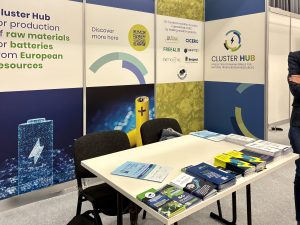
Production of raw materials for batteries from European resources
After Wednesday’s sessions on the EU political agenda, which outlined strategic measures to meet industry needs, attention shifted to the annual workshop of the Materials for batteries hub. Now in its 4th edition, the event was co-organised by Horizon Europe projects RELiEF, FREE4LIB, RESPECT and LITHOS. The focus of the workshop, true to its eponymous theme, was tackling one of Europe’s most urgent challenges: securing sustainable raw materials for batteries.
Under the inauguration of Oliver Schenk, Member of the European Parliament, this edition unfolded under the auspices of urgency, regulatory clarity and cross-border collaboration. The MEP called for swift implementation of the Critical Raw Materials Act and the Net Zero Industry Act, stressing the need for rapid permitting and the mobilisation of both public and private investment. “We cannot afford delays,” he warned. “This is about sovereignty.” His remarks were followed by strong appeals for cooperation among mining regions, manufacturing clusters, research centres and recycling hubs to build a resilient European value chain. He urged participants to contribute to upcoming legislative files, including the European Chips Act 2, the Circular Economy Act and the new EU budget, ensuring that the priorities of the battery materials community are embedded in future policies.
Nader Akil, founder of the Cluster Hub and moderator of the first technical session, emphasised on enhancing the dialogue between academia, industry and policy makers in order to ensure that these goals would be reached.
Following up with a presentation of his most recent scientific publication – “Lindy Effect in Hydrometallurgy” [co-authored with Dr. Ir. Peter Tom Jones] – Professor Koen Binnemans provided a frank look at the shortcomings in industrialising battery material innovations. Transferring hydrometallurgical advancements from lab to plant is slow, constrained by economics, regulation and what the authors call “the Lindy effect” – the tendency for established technologies to stand the test of time. Industry tends to favour incremental improvements to existing processes, such as reducing reagent consumption or increasing automation, rather than adopting entirely new chemistries, due to the high risks and costs associated with large-scale change. Launching a debating topic, audience questions shifted to technical and permitting challenges, concluding with the need for incremental innovation and pragmatic timelines.
Download the presentation
Various EU-funded R&I initiatives, members of the Cluster Hub, presented results and findings with the promise to reduce dependency on imports. RHINOCEROS project presented its intermediary results within the technical session “Recycling and circularity”, alongside sister projects RELiEF, RESPECT and FREE4LIB.
- Alvaro Manjon (TECNALIA) detailed the RHINOCEROS project’s progress in automating battery disassembly, optimising recycling routes and upscaling processes for high recovery rates of battery materials, with a focus on sustainability and safety. The project is transitioning from R&D to construction and commissioning of pilot plants, with detailed engineering completed. Upscaling activities focus on refining, pre-treatment, and qualification of recovered materials for use in new batteries, aiming for TRL 6 and production of tens of kilograms of electrode materials per day. RHINOCEROS integrates circularity and zero-waste strategies, with ongoing validation of recovered materials in prototype batteries.
Download RHINOCEROS presentation - Thomas Opsomer (ABEE) presented the final results of RELiEF, a project that achieved a reduction in hazardous elements, developed a microwave leaching process with over 95% yield, and produced high-purity lithium carbonate (98.28%); while not yet battery grade materials, recovered lithium carbonate showed promising results in relithiation tests. The lithium carbonate produced was successfully tested in coin and pouch cell formats, demonstrating high reproducibility and performance close to commercial LFP materials. Opsomer emphasised the growing importance of LFP batteries in Europe and the lack of recycling capacity, noting that extended producer responsibility (EPR) regulations now require battery integrators to address recycling, registration, and reporting. This creates both administrative burdens and incentives for recyclers, with recycling fees sometimes reaching 30% of battery unit costs.
Moreover, RELiEF’s “balance sheet” listed its unsolved challenges which include insufficient black mass refining capacity and the upscaling of innovative technologies. On the other hand, opportunities include standardising black mass quality, implementing direct recycling methods and the development of regional ecosystems that connect recyclers, OEMs and policymakers to promote sustainable business models.
Download RELiEF presentation - FREE4LIB, presented by Juan Castro Bustamante (CARTIF), combines robotic dismantling, material recovery with a digital battery passport for traceability. The project achieved pilot-scale robotic dismantling, developed advanced state-of-health estimation tools for second-life batteries and implemented multiple pre-treatment and recycling technologies, including pyrolysis, ultrasonic delamination and hydrothermal routes for cathode material recovery. Recovered metals and polymers were reused in new battery packs, including e-bike prototypes, with successful demonstration of material quality and performance. The project also established a pilot line for metal powder atomization and 3D printing of recovered plastics.
Project partners developed a digital passport featuring role-based access, blockchain integration, and QR labelling to enhance traceability and regulatory compliance. The platform will be made available for public access by the end of the project.
Download FREE4LIB presentation - RESPECT, represented by Andrea Locati (Chalmers University), presented the project’s developed flowsheet for solvent extraction and recovery of manganese, cobalt and nickel from black mass, achieving high purity and minimal cross-contamination. The recovered salts were used by CEA to produce cathode active materials, with up to 20% recycled content in electrodes, showing how the targets proposed by the Critical Raw Materials Act and the Battery Regulation are achievable. The approach allows for flexibility in product output, enabling adaptation to different NMC chemistries or other applications. Challenges include the complexity of operations, need for recirculation to minimise losses and adjusting process parameters to variable feed compositions.
The conclusions of the RESPECT presentation emphasised the need to propose clear definitions of battery-grade materials and the importance of aligning process outputs with regulatory requirements.
Download RESPECT presentation
Debating industrial integration, collaboration and European competitiveness
The second panel discussion, following technical session #2, moderated by Olga Henkele (Kellen) and inviting Joana Gouveia (INEGI), Sam Hoefman (EURICE) and Dr. Florian Anderhuber (Euromines) as guests, reflected on how Europe can progress from promising battery recycling innovations toward a more operational and industrial circular economy. Speakers agreed that while European research projects are generating strong technical evidence, several barriers still remain before a fully closed loop can be achieved. It addressed policy and market dynamics:
- Barriers to circularity: panelists emphasised the need for economically viable recycling in Europe and reducing regulatory burdens on recyclers. Other recommendations placed the time gap between research and industrial implementation, as well as cross-collaboration communication channels between academia, industry and policy makers as drivers of European industrial competitiveness.
- Florian Anderhuber highlighted lengthy permitting processes for new technologies and the lack of demand-side measures such as recycled content requirements. He stressed the need for financial support and market incentives to stimulate recycling and primary sourcing within Europe.
- Panellists discussed the importance of feeding clear evidence from EU-funded projects into policy making, setting clear project objectives, and considering the life cycle of projects from inception to exploitation. Joanna Gouveia, while emphasising on the LCA approaches in project, provided a direct example from the RELiEF project, where policy definitions limited the classification of secondary lithium, suggesting the need for broader definitions.
Read the entire review article
The last consortium meeting included a session dedicated to ongoing clustering activities, where the RHINOCEROS partners invited the RESTORE project coordinator, Christophe Aucher, Area Manager Energy Storage at LEITAT. The objective of this initiative is to introduce the two EU-funded projects, both focusing on advancing battery material treatment and recycling technologies. Both projects are members of the Cluster Hub “Production of raw materials for batteries from European resources”.
The RESTORE project introduced its approach to treat black mass – from sorting to discharging, retrieving all available materials and validating them in a coin battery. This concept aligns closely with the philosophy of the RHINOCEROS project, emphasising the importance of contactless sorting and efficient battery discharge processes. The aim of RESTORE is to remove cables and discharge batteries within 40 minutes, which would bring a big step towards more efficient recycling processes.
During the event, representatives of both projects addressed various industry challenges. One major issue is the profitability of selling black mass to states outside of EU, compared to the domestic scenario for producing electrodes. Additionally, the European market faces a slowdown in battery production, showing citizens preference for hybrid cars over electric vehicles. Nevertheless, both sides agreed on the need for critical raw materials, indispensable to emerging industrial sectors, underscoring the importance of sustainable and efficient recycling processes.
The RESTORE project introduced several technological advancements, including the KYBURTZ cell-to-electrode direct recycling method developed by VITO. This method aims to streamline the recycling process and enhance the quality of recovered materials.
Although the two projects share similar objectives and consortium partners, technical questions were not missing, addressing mainly the electrochemical recovery of lithium, the impact of the aqueous media on the quality of retrieved material and the potential to work in batch mode.
This first online encounter of RHINOCEROS and RESTORE sparks a lot of curiosity, key ingredient of innovation and technological advancement. Prospects already show opportunities to stimulate collaborations and knowledge exchange in the battery recycling R&I field.
The second day of the RHINOCEROS M24 meeting featured the presentation of the TranSensus LCA project, delivered by Prof. Dr. Ing. Thilo Bein. This cross-collaboration initiative aimed to open cooperation activities between the two projects, focusing on the development and application of a harmonised life-cycle assessment (LCA) approach for zero-emission road transport.
Prof. Dr. Ing. Thilo Bein presented the TranSensus LCA project, coordinated by Fraunhofer and launched in January 2023. The project aims to establish a commonly accepted and applied LCA approach for zero-emission road transport while developing a framework based on European data. This initiative involves stakeholders from industry, research, standardisation bodies and the European Commission. The project’s scope could extend internationally, with coordinators planning a wider stakeholder consultation to inform further guidelines and policy recommendations.
Download TranSensus presentation
Potential collaboration routes between RHINOCEROS and TranSensus on LCA topics
The exchange of questions and ideas during the presentation spurred significant interest and facilitated collaboration opportunities between the two projects. The representatives of RHINOCEROS LCA work package received invitations to participate in future trainings organised by TranSensus. These workshops are designed to equip participants with advanced knowledge and skills in life-cycle assessment methodologies. By integrating the harmonised LCA approach proposed by TranSensus in the future, RHINOCEROS has the possibility to contribute to the broader goals of this coordination and support initiative and potentially influencing policy development.
Discussions about LCA raised additional questions about life-cycle costing (LCC). Although not comprised in the scope of work of TranSensus, future guidelines will include also recommendations on how to tackle LCC in common approach. TranSensus will continue publishing reports and guidelines towards the end of this year. Among other topics, these deliverables will address:
- Modelling technology penetration in the market
- Recommendations on how to model the energy mix for sensitivity analysis
- Various use cases, RHINOCEROS being a potential candidate for this category
Discover TranSensus deliverables
Despite a different objective, the RHINOCEROS project partners have shown growing interest in the Digital Battery Passport, an initiative of FREE4LIB, a sister project from the Cluster Hub “Production of raw materials for batteries from European resources”. This collaboration shows our commitment to contributing to the European battery community through the exchange of knowledge and experience.
The FREE4LIB workshop had a three-fold objective, including a brief presentation of the preliminary results of the battery passport concept development, the outline of the implementation challenges and potential follow-ups of industrial scale-up, and the clear differentiation between battery second use (B2U) versus recycling. The event drew approximately 50 participants from various segments of the battery value chain, which ensured a comprehensive and multifaceted perspective of the subject matter.
The introductive session presented the FREE4LIB project, briefly highlighting past achievements and focusing mainly on the remaining activities outlined in the workplan. The following session was led by Julius Ott (industrial engineer with expertise in circular economy at Karl-Franzens-Universität Graz). During the past year, researchers at Univ. of Graz worked on finalising data collection and processing related to the development of a data model of the digital passport platform which aims to close the information gap between beginning-of-life (BoL) and end-of-life (EoL) battery lifetime. This interactive session turned out to be an appropriate opportunity for researchers at Univ. of Graz to present the outcomes of their data collection and handling, and to evaluate their relevance within the reality portrayed by the workshop attendees.
Participants, predominantly familiarised with the EU-funded battery projects, confirmed the findings reported by Univ. of Graz. However, they also raised concerns about data sharing. The outcomes of the interactive session, complementing prior research, will serve as valuable guidance for the FREE4LIB project in implementing the battery passport within their project.
For additional background information on the digital passport developed by FREE4LIB, please refer to previous articles.
On Thursday, 16 November, during the 2023 edition of the Raw Materials Week, the twelve EU funded projects that constitute the Cluster Hub ‘Materials for batteries’ gathered for their annual event in Brussels.
The Cluster Hub has been initiated last year during the 7th edition of the Raw Materials Week. The main objective of the meeting was to meet and discuss the latest developments in the participating projects as well as the new challenges and opportunities discovered through the projects’ lifetime. Nader Akil, Operations Manager at PNO Innovation, inaugurated this second edition outlining the motivation behind the hub’s establishment. He underlined the positive reception and sustained interest from various stakeholders keen on joining this initiative.
Discover and/or rediscover the first edition of the Cluster Hub workshop
Co-organised by RELiEF, EXCEED, ENICON and RAWMINA, the event was also the opportunity to welcome the four new members of the Cluster (EXCEED, RAWMINA, METALLICO and CRM-geothermal). the workshop gathered nearly 100 organisations driving the production and the recycling of raw materials for battery applications from primary and secondary resources.
Building on the initial objective of creating an environment that could foster knowledge exchange on different approaches for the recycling and recovery for battery applications, the event focused on three major topics that depict the transversality characterising the projects: the raw materials through research and science, the roles and challenges of industry and market for raw materials, and the raw materials under the scope of sustainability, durability and social acceptance. During this annual meeting, an interactive session led by Anish Patil from TechConcepts and representing the RELiEF project had the objective of Mapping the European battery material recycling landscape – more details to be found below, in the section referring to the interactive session.
Research and science unlocking new opportunities in raw materials
The first session was moderated by Sonia Matencio from LEITAT, representing the RAWMINA project. This session had the objective of discussing the raw materials through research and science, under the scopes of mining, refining, processing as well as the battery data. Sonia introduced this topic under the scope of RAWMINA, explaining the integrated innovative pilot system for Critical Raw Materials recovery from mine waste in a circular economy context. To this end, Christophe Aucher, from LEITAT as well, highlighted the need on an open battery passport system to better reflect and account for any adaptations that might be required due to the changing regulatory landscape.
Sonia welcomed afterward Brecht Dewulf from KU LEUVEN and representing ENICON, who discussed the sustainable processing of Europe’s low grade sulphidic and lateritic Ni/Co ores and tailings into battery grade metals. The idea behind this was to show all the potential of Ni/Co resources for Europe.
Xochitl Dominguez from VITO concentrated her speech on gas-diffusion electrocrytallisation (GDEx), a crucial topic for the projects LiCORNE and RHINOCEROS she works with. GDEx is an electrochemical process of reactive precipitation of metals in solution with oxidising or reducing agents produced in-situ by the electrochemical reduction of a gas, in a gas-diffusion electrode. This was followed by Katrin Kieling from GFZ Potsdam, working there for the CRM-geothermal project and shortly explained the challenges of extracting critical raw materials from geothermal fluids. To conclude this first session, Sandra Pavón from Fraunhofer IKTS explained the demonstration of battery metals recovery from primary and secondary resources through a sustainable processing methodology in the METALLICO project.
Discover presentations from Session 1
Insights from stakeholder perspectives: Interactive session on key EU Policies and priorities
The annual meeting followed its course with an interactive session led by Anish Patil, which scrutinised stakeholders’ perspectives on the Green Deal Industrial Plan, Net Zero Industrial Act, Critical Raw Materials Act and the European Battery Regulation 2023. Mentimeter facilitated this interactive session, engaging the audience to explore how these policies intersect, complement each other, and identify critical measures and incentives for achieving their objectives.
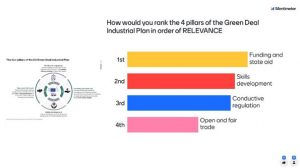
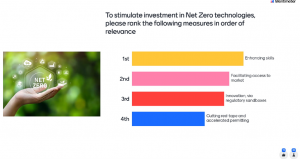
Over 30 persons participated in the live-poll proposed, which results display the priority to be set on funding and state aid regarding ranking the four pillars of the Green Deal Industrial Plan in order of relevance (followed by skills development, conductive regulation, and open and fair trade). Another major topic regarding the stimulation of investment in net Zero technologies, the majority of answers placed the ‘enhanced skills’ as first priority, shortly followed by facilitating the access to the market.
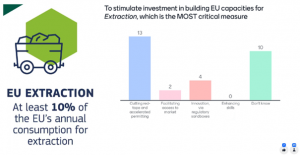
Lastly, the participants were divided regarding the critical measures to implement in the EU to stimulate investment in building domestic capacities for extraction of critical raw materials (CRMs). Although the majority opted for ‘cutting red-tape and accelerated permitting’, approximately half of the answers evoked uncertainty, which emphasised one more time the need to engage with policy makers as external stakeholders in all projects.
Navigating the nexus: industry challenges, market dynamics, social acceptance and sustainability
This interactive workshop was followed by two sessions, which aimed at discussing the challenges and opportunities of raw materials within the frame of industry and market, as well as the social acceptance, sustainability, and durability.
Alan Gonzalez from PNO Innovation Begium, representing LiCORNE, moderated the industry part, whereas Sam Hoefman from RELiEF moderated the last session on social acceptance, sustainability, and durability. Distinguished panellists took the stage to engage in debates on various topics.
Edvarts Emerson, Production and Testing Engineer at Watt4Ever, presented his work on the benchmark depository of 2nd life use of lithium in batteries, acceptance criteria and guidelines, work developed within the RHINOCEROS project. Benjamin Wilson, representing the RESPECT Project, displayed Aalto University’s work advancing efficient, sustainable, innovative and safe battery recycling processes in the EU. Laura Kainiemi from LUT University, representing the RELiEF Project, Konstantinos Komnitsas from the Technical University of Crete (TUC), on behalf of EXCEED, and Vitor Correia from INTRAW for the CRM-geothermal project, collectively debated the role and impact of social acceptance among affected communities, the importance of triggering new dialogues on responsible mining activities, and the joint involvement of regional, national and European authorities, academia, industry partners, and citizens in shaping these initiatives.
A big thank you to all participants for this co-creative and very constructive and inspiring meeting.
Discover presentations from Session 2
Discover presentations from Session 3
Part of the Cluster Hub “Production of raw materials for batteries from European resources”, the RHINOCEROS consortium received the online visit of FREE4LIB representatives during the second day of the Consortium meeting held in Gothenburg. This initiative including stakeholders involved in different European R&D initiatives goes beyond building a knowledge exchange ecosystem to address common topics related to EU-funded projects; it paves new collaboration routes and synergies aiming at driving innovations for the recycling of batteries and the production of raw materials for battery applications from primary and secondary resources available in Europe.
Represented by Julius Ott (industrial engineer with expertise in circular economy at Karl-Franzens-Universität Graz) and Pau Sanchis (senior policy officer Eurobat), the FREE4LIB presentation focused mainly on the Digital Battery passport and the relevant legislative situation at European level.
Pau Sanchis referred to the Digital Battery Passport in the context of the new regulation on batteries and waste batteries which entered into force on 17 August 2023. According to this update, thoroughly explained in Art. 77, the battery passport should contain information “relating to the battery model and information specific to individual battery, including resulting from the use of that battery”.
“Batteries should be labelled in order to provide end-users with transparent, reliable and clear information about batteries and waste batteries. That information would enable end-users to make informed decisions when buying and discarding batteries and waste operators to appropriately treat waste batteries. Batteries should be labelled with all the necessary information concerning their main characteristics, including their capacity and the amount of certain hazardous substances present. To ensure the availability of information over time, that information should also be made available by means of QR codes which are printed or engraved on batteries or are affixed to the packaging and to the documents accompanying the battery and should respect the guidelines of ISO/IEC Standard 18004:2015. The QR code should give access to a battery’s product passport. Labels and QR codes should be accessible to persons with disabilities, in accordance with Directive (EU) 2019/882 of the European Parliament and of the Council (17).”
The policy officer emphasised the role of the standardisation process on the Battery Passport, which requires the Commission to adopt implementing decision requesting European Standardisation Organisation to develop standards in support of Ecodesign by December 2023. Standards regarding the technical design and operation of the Battery Passport are expected to complement provisions under Art. 78. According to the timeline presented in the regulation, the first application of the battery passport is expected in 2027. From 18 February 2027 onwards, “all batteries shall be marked with a QR code as described in Part C of Annex VI.
The new regulation aiming at strengthening sustainability rules for batteries and waste batteries will be supported by various secondary legislation pieces which will ensure all the requirements will be developed and implemented effectively. The QR code shall provide access to the following:
- for light means of transport (LMT) batteries, industrial batteries with a capacity greater than 2kWh and electric vehicles batteries, the battery passport in accordance with Article 77.
- for other batteries, the applicable information referred to in paragraphs 1 to 5 of this Article, the declaration of conformity referred to in Article 18, the report referred to in Article 52(3) and the information regarding the prevention and management of waste batteries laid down in Article 74(1), points (a) to (f).
- for starting, light, and ignition (SLI) batteries, the amount of cobalt, lead, lithium or nickel recovered from waste and present in active materials in the battery, calculated in accordance with Article 8.
The policy overview presentation was complemented by the technical presentation undertaken by Karl-Franzens-Universität Graz, that will develop a data model of the digital battery passport platform aiming to close the information gap between beginning-of-life (BoL) and end-of-life (EoL) battery lifetime. Relying on knowledge generated previously by Univ. of Graz, the researchers set an objective to define clear user roles and establish access to certain information. Up to this moment, the work carried out has been focusing on data collection and data handling (data points sorting) on the other side. This specific work encountered various challenges, notably the users willingness to share information, process standardisation, the variety of products, the recycling cost/revenue ratio, the dynamic development of the legislative framework, to name a few.
Learn more about the progress on the battery passport on the FREE4LIB website.
